


March 2026 was marked by an unprecedented situation in which the activities of the United States Patent and Trademark Office (USPTO) became the subject of intense political confrontation in the United States Congress. During oversight hearings in the House of Representatives, the agency’s Director, John Squires, faced sharp criticism regarding the USPTO’s role in registering trademarks for the Board of Peace initiative, associated with the sitting U.S. President, Donald Trump.
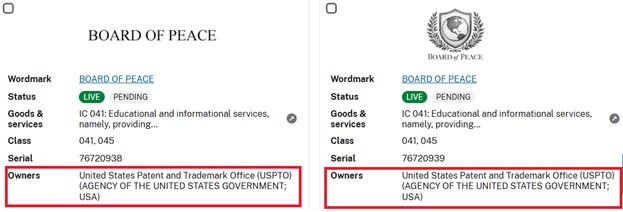
The central accusation came from Congressman Jamie Raskin, who stated that the USPTO may have effectively facilitated the concealment of information about who controls and profits from “Board of Peace.” According to him, instead of requiring disclosure of the applicant legal entity—a standard practice in trademark law—the agency itself filed the applications in its own name. In Raskin’s view, this may have allowed key transparency requirements to be circumvented and created conditions for the operation of a non-transparent financial structure.
This concerns two trademark applications that the USPTO filed on its own behalf for an entirely unrelated organization.
During the hearings, Jamie Raskin described the initiative as a “secret slush fund” and questioned its constitutionality, emphasizing that the issue extends beyond intellectual property to the potential use of a government body to serve private or political interests.
In response, USPTO Director John Squires denied any allegations of improper coordination with the presidential administration. He explained that the USPTO acted on national security grounds and to prevent so-called “cybersquatting”—a situation in which third parties rapidly register the names of high-profile projects for speculative purposes or to block their use. According to him, the agency acted only as a temporary applicant, and once an appropriate legal entity is established, the trademark rights are to be transferred to it.
The Board of Peace project itself, proposed in the fall of 2025, is positioned as an international structure to support peacekeeping processes, particularly in the context of the conflict in Gaza. Its charter предусматривает the participation of states with the possibility of obtaining permanent membership in exchange for substantial financial contributions, which further intensifies concerns about control over funds and governance of the organization.
A separate line of criticism during the hearings was raised by Congressman Darrell Issa, who drew attention to potential conflicts of interest within the broader system of intellectual property governance. In particular, he questioned the role of Secretary of Commerce Howard Lutnick, under whose jurisdiction the USPTO operates, pointing to the possible influence of his private patent interests on bodies that adjudicate patent disputes.
Thus, the situation extends far beyond an isolated trademark case. It exposes a systemic issue: whether an agency that traditionally performs a technical and administrative function of registering intellectual property rights can remain outside political processes when such rights become instruments of influence, financing, and even geopolitics.
The scandal surrounding the USPTO demonstrates the transformation of the role of intellectual property in the modern world. A trademark is no longer merely a means of distinguishing goods or services—it can serve as an element of complex legal structures that affect financial flows, political projects, and international relations. Accordingly, the level of requirements for transparency, accountability, and ethical conduct of the bodies administering these rights is also increasing.
Ultimately, the “Board of Peace” case may become precedent-setting. It raises a fundamental question for the U.S. legal system: whether existing trademark procedures are sufficient to prevent their use in political or financial schemes, and whether it is time to reconsider the scope of authority of institutions such as the USPTO in a new reality where intellectual property increasingly intersects with public law and state policy.
Founder of Research & Patent group Intectica, author of patent algorithms for solving problems in the pharmaceutical industry, patent attorney certified in all intellectual property objects (Patents, Design, TM), with education in chemistry and law, chief expert of the patent institution of Ukraine UKRPATENT (1997-2004). Member of international organizations, including ECTA, PTMG, UAM, lecturer and blogger.