


The Indian trademark system has taken a step that until recently seemed almost impossible: the Indian Trade Marks Registry has, for the first time, accepted for examination an application for a so-called “smell mark” — a trademark defined not visually, but by scent. The application in question was filed by Sumitomo Rubber Industries Ltd. for a sign described as “a floral fragrance reminiscent of roses, applied to tyres” (Class 12). This decision represents not only a technical innovation, but also a challenge to the fundamental principles of trademark law.
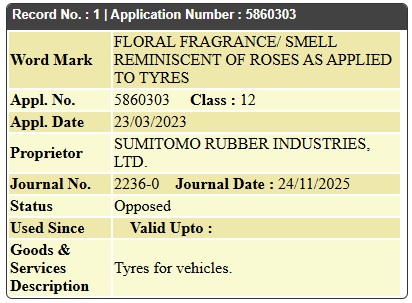
Traditionally, trademark law has been built around visually perceptible signs — words, logos, colors, or shapes. However, modern approaches, as reflected in particular in the TRIPS Agreement, allow for an expansion of this list, provided that the sign is capable of performing its essential function — identifying the commercial origin of goods. This is precisely what raised a key question for Indian law: can a scent, as a subjective sensory perception, perform such a function?
Under the Trade Marks Act, 1999, a trademark must satisfy two main criteria: it must be capable of graphical representation and possess distinctiveness. These requirements have been the principal obstacle to the registration of scent marks. At the initial stage, Sumitomo’s application was refused on the grounds of lacking both adequate graphical representation and sufficient distinctiveness. However, during the appeal process, the case took on an entirely new dimension.
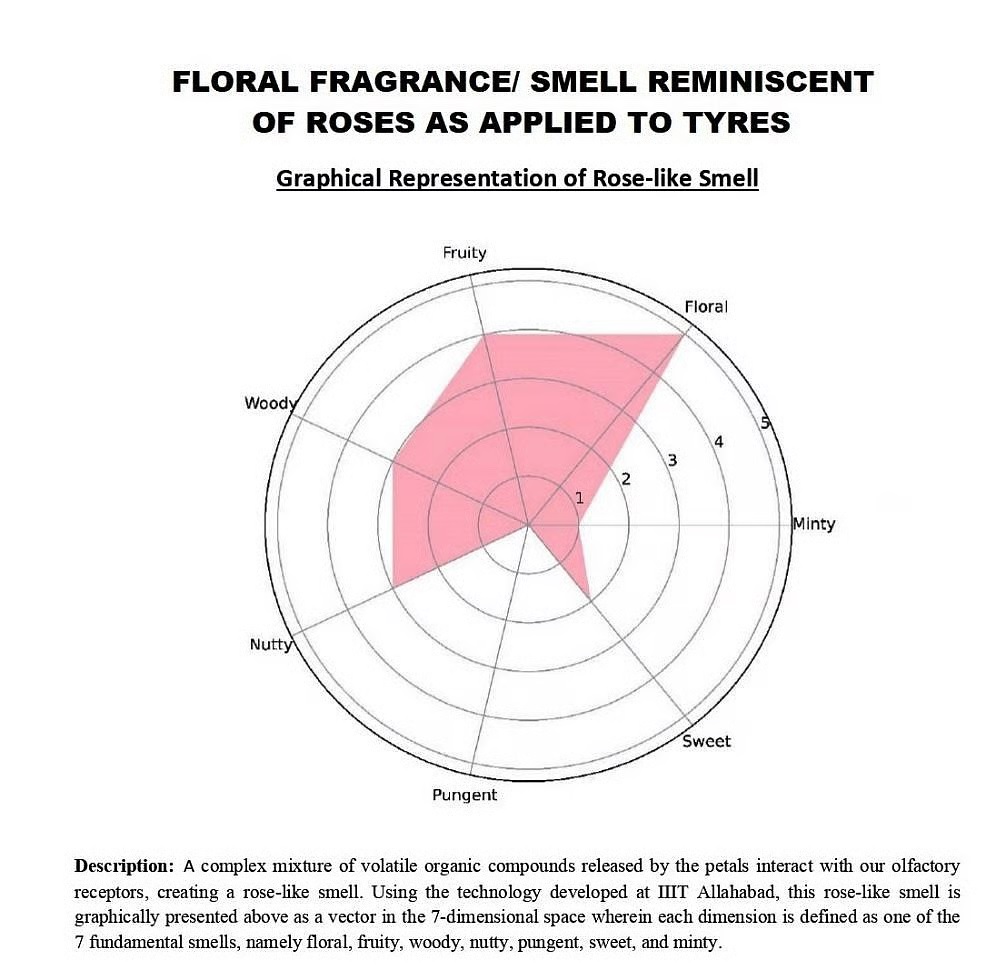
A key breakthrough was the use of a scientific approach to the “representation” of scent. Researchers from the Indian Institute of Information Technology, Allahabad proposed a model that represents a fragrance as a vector in a seven-dimensional space, where each axis corresponds to a basic category of smell — floral, fruity, woody, nutty, pungent, sweet, and minty. Within this model, the scent of roses is assigned specific numerical values, making it possible to “fix” it as an object of legal protection. The Registry considered such representation sufficiently precise, clear, and objective to satisfy the requirement of graphical representation.
The issue of distinctiveness was equally important. Sumitomo argued that the scent of roses is arbitrary in relation to tyres, meaning it has no functional or natural connection with the goods. This implies that such a scent can serve as an indicator of origin. In addition, the company claimed long-term use of this feature (since the 1990s), allowing for the recognition of acquired distinctiveness — where consumers associate a particular scent with a specific manufacturer.
The international context of this case shows that India is not the first mover, but its approach is among the boldest. At the same time, this decision raises a number of complex issues. First, can the average consumer realistically perceive and identify a “scent vector” as a trademark? In practice, the enforcement of such rights will clearly require expert analysis and may complicate litigation. Second, there is a risk of over-monopolization: if scent becomes an object of legal protection, companies may begin to actively patent or register sensory characteristics of their products, creating multi-layered barriers to competition.
Particular attention should be paid to the potential impact on other industries, especially the pharmaceutical sector. In theory, if a medicinal product has a distinctive scent, its registration as a trademark could extend commercial exclusivity even after patent protection expires. This creates risks for access to generics and calls for careful regulatory oversight.
From a consumer perspective, scent is indeed a powerful tool for memorization and can function as a brand identifier. However, it remains subjective and context-dependent. Will it be sufficient that a certain number of consumers associate the scent of roses with a particular tyre manufacturer? This question will likely become the subject of future disputes.
In a broader sense, the Sumitomo case demonstrates the transformation of intellectual property law under the influence of technological developments and marketing strategies. The market is moving toward multisensory branding, and the law is being forced to adapt to new realities. By accepting this challenge, India has effectively opened a new direction of development — “olfactory” jurisprudence.
In conclusion, the decision to accept a “smell” trademark is not a final point, but rather the beginning of a discussion. It creates a precedent while also raising fundamental questions about the limits of legal protection, the balance between innovation and competition, and the ability of the law to adequately respond to intangible yet commercially significant phenomena. Whether this will remain an isolated case or become the beginning of a new practice will depend on how Indian courts, legislators, and businesses respond to this “fragrant” challenge.
Founder of Research & Patent group Intectica, author of patent algorithms for solving problems in the pharmaceutical industry, patent attorney certified in all intellectual property objects (Patents, Design, TM), with education in chemistry and law, chief expert of the patent institution of Ukraine UKRPATENT (1997-2004). Member of international organizations, including ECTA, PTMG, UAM, lecturer and blogger.