


The Hidden Driver of Access (or Failure) in #Pharma
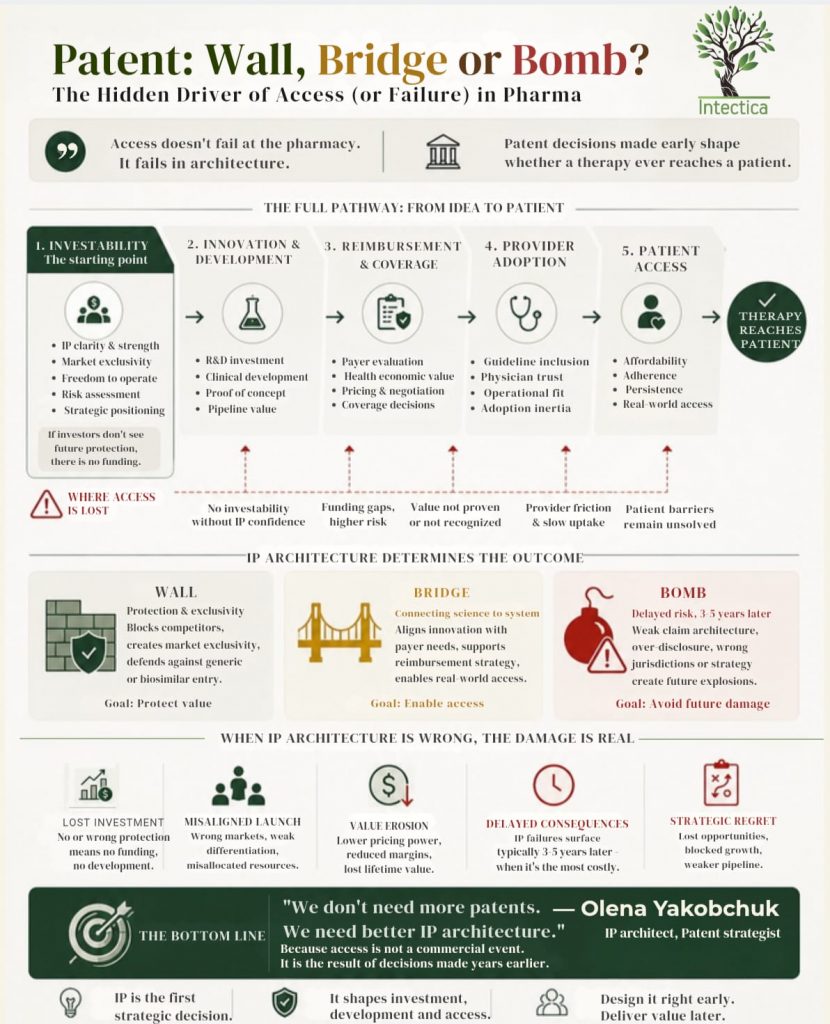
We often discuss where access is lost in pharma — at the level of reimbursement, physician adoption, or patient adherence. Entire frameworks are built around these gaps.
But there is a layer that is rarely addressed directly.
Not where access is lost —
but where it is never created in the first place.
Before a product reaches development, before clinical trials, before any discussion with payers — there is a much earlier decision point: #investability.
If an investor does not clearly see future protection, strategic positioning, and the ability to defend value — the project simply does not move forward.
🔹 No funding means no development.
🔹 No development means no product.
🔹 No product means no access.
This is where #intellectual property plays a much deeper role than it is usually given.
In many teams, a patent is still treated as a formal step — something to “complete” before moving into the next phase. A kind of checkpoint that creates a sense of security: protection is in place, the process can continue.
❕ But in reality, the question is not whether a patent exists.
From my perspective, a patent is never neutral. It becomes one of three things.
A patent becomes one of three things:
1. A Wall
Protection, exclusivity, market control for a defined period of time. This is the classical and expected function.
2. A Bridge
A much more strategic role, connection between science, product, system and real-world use. This is where access is not left to chance, but designed in advance.
3. A Time Bomb
The most underestimated scenario.
Weak structure, over-disclosure, or wrong strategy —
and it often detonates 3–5 years later,
exactly when the product enters the real market.
The question is what kind of structure it creates.
This is the most underestimated scenario. Everything may look correct at the beginning:
the filing is done, the documentation is in place. But structural weaknesses remain: overly broad or poorly constructed claims, unnecessary disclosure of know-how, misalignment across jurisdictions, or failure to anticipate how the system will evaluate the product.
These issues do not surface immediately.
They often appear 3️⃣ – 5️⃣ years later, when the product reaches the most critical stage — pricing, reimbursement, and real market entry.
At that point, they are no longer theoretical. They become expensive, and often irreversible.
This is why many so-called “access failures” are not truly commercial problems. They are the result of earlier structural decisions — most of them made at the level of IP.
___________________________________________
We do not just need better forecasting models.
We need to think earlier.
Because in pharma, a patent is not the end of development.
It is the beginning of market reality.
#PharmaStrategy #MarketAccess #PatentStrategy #IPArchitecture #DrugDevelopment #Investability #HealthcareStrategy #Yakobchuk