


When we hear about great inventions, our imagination paints a picture of a sterile laboratory where a scientist in a white coat develops a cure for incurable diseases or designs the next world-changing gadget. However, the archives of the US Patent Office prove that the line between genius and utter absurdity can sometimes be very thin. Among millions of documents hide ideas that make you wonder whether their creators shouldn’t have been trusted with tools in the first place.
The most surprising part is that government experts reviewed these projects in all seriousness, stamped them with official seals, and recognized them as “official inventions.”
Meet the “Baby Centrifuge”
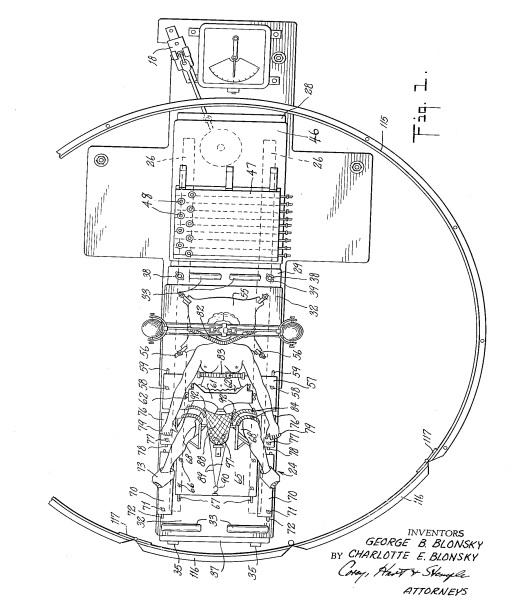
One of the most jaw-dropping examples of such a “flight of fancy” is US Patent No. 3,216,423, issued in 1965. Officially, it is titled “Apparatus for Facilitating the Birth of a Child by Centrifugal Force.” It was created by a married couple, George and Charlotte Blonsky.
How was it supposed to work? Imagine this: a woman is preparing to become a mother. She is exhausted and in pain. What solution do the Blonskys offer? A pregnant woman in the final stages of labor would be securely strapped with belts to a special table. The machine would turn on and spin at a furious speed, creating a G-force of $8g$ (for perspective: astronauts experience several times less pressure during a rocket launch). According to the Blonskys’ design, this force was meant to literally launch the newborn out of the mother’s womb, compensating for the weakness of her muscles. The inventors sincerely believed that “civilized” women were too weak compared to their distant ancestors, and therefore required mechanical assistance.
Safety First (Or Not)
The inventors did, however, make sure the baby wouldn’t fly straight into the wall. The patent describes safety measures in great detail:
-
The Catching Net: A soft net was attached between the mother’s legs, designed to “catch” the newborn “pilot.”
-
The Alarm System: When the baby landed in the net, its weight would press on a sensor, ringing a bell in the room. This was the signal for the doctor: “Done! You can stop the ride.”
-
Brakes and Counterweights: The device featured a complex balancing system (to keep the table from shaking violently under the patient’s weight) and emergency brakes.
Why Don’t We See This in Hospitals?
Despite the patent being officially granted, not a single maternity hospital in the world dared to install this “amusement ride of death.” The entire process resembled a cross between a horror movie and a crazy carnival carousel.
Fun fact: George and Charlotte Blonsky had no children of their own. Perhaps that is why it was so easy for them to theorize about “facilitating” childbirth by spinning a woman into oblivion.
This invention has forever remained in history as a monument to human imagination, which sometimes knows no bounds—neither logical nor physical. Today, this patent is remembered with a smile as a piece of “mad science” that attempted to solve natural matters in the most unnatural way possible.
Founder of Research & Patent group Intectica, author of patent algorithms for solving problems in the pharmaceutical industry, patent attorney certified in all intellectual property objects (Patents, Design, TM), with education in chemistry and law, chief expert of the patent institution of Ukraine UKRPATENT (1997-2004). Member of international organizations, including ECTA, PTMG, UAM, lecturer and blogger.