


A new intellectual property scandal has erupted in the world of modern retail. This time, the center of attention is a simple flamingo-shaped egg cup, which has become a bone of contention between independent British ceramicist Hannah Turner and the large Australian store chain The Reject Shop.
A Striking Resemblance
While working in her studio in southwest England, ceramicist Hannah Turner discovered that her own work had been plagiarized in Australia. A photograph of the local retail chain’s products featured all the key elements of her signature design—from the distinctive feather coloring to the shape of the feet—indicating that her creative work had been copied by a major retailer.
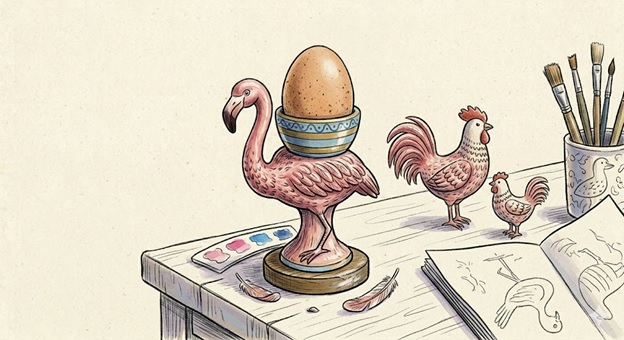
The price difference turned out to be colossal: an original egg cup from Turner costs around $62, whereas the discount chain offered its “analog” for just $5. “It’s a real battle of craft versus capitalism,” Hannah notes, emphasizing that supporting independent designers is vital for original items to exist in the market.
The Retailer’s Response: A “Gesture of Goodwill” Without Admission of Guilt
The artist contacted The Reject Shop, demanding an immediate halt to the sale of the copies and the destruction of the remaining stock. The company’s legal department responded quite cautiously, stating that the claim did not contain sufficient legal grounds for such radical steps within the territory of Australia.
However, to settle the conflict, the chain resorted to a compromise: they promised not to reorder this product from suppliers once the remaining stock (approximately 1,350 units) is sold out. For the artist, such an outcome is only a partial victory, as she received no financial compensation, and legal battles with a large corporation require budgets that small businesses simply do not have.
Legal Subtleties and Copyright Traps
Although Australia and the United Kingdom adhere to the Berne Convention, which automatically protects creators’ copyrights in both countries, proving theft in court is extremely difficult. Experts highlight several critical points:
-
The Subjectivity of a “Substantial Part”: To win the case, it must be proven that the creative expression itself was copied, rather than just the idea of a flamingo.
-
Idea vs. Expression: Copyright does not protect the mere idea of creating a bird-shaped cup, as the number of ways to depict a flamingo is limited by the animal’s anatomy.
-
The Cost of the Process: For individual artists, justice often remains out of reach due to the high cost of legal services.
New Challenges: Artificial Intelligence
The situation is further complicated by the development of AI. Modern algorithms are capable of scanning the web for popular designs and creating “similar, but not identical” templates based on them for mass production. This creates a “gray area” where it becomes increasingly easy for large companies to evade direct liability for plagiarism.
The story of the flamingo egg cup serves as yet another reminder for consumers: behind the low price of the mass market often lies the unpaid labor of an artist whose ideas fall victim to big profits. Meanwhile, Hannah Turner continues her work, hoping that the publicity surrounding this situation will force major market players to treat the intellectual labor of others with greater respect.
Founder of Research & Patent group Intectica, author of patent algorithms for solving problems in the pharmaceutical industry, patent attorney certified in all intellectual property objects (Patents, Design, TM), with education in chemistry and law, chief expert of the patent institution of Ukraine UKRPATENT (1997-2004). Member of international organizations, including ECTA, PTMG, UAM, lecturer and blogger.