

Just days after singer DARA brought victory to Bulgaria at Eurovision with her hit “Bangaranga,” a real legal battle has erupted over the song’s title. A third party has decided to capitalize on the track’s massive popularity and register a visual trademark containing the word “Bangaranga” as an official European trademark.
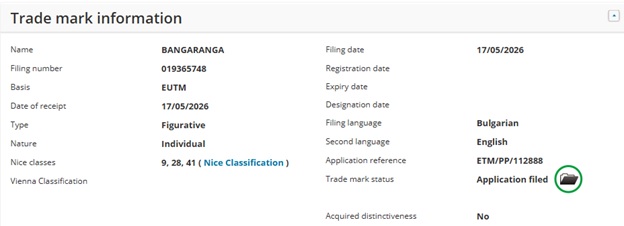
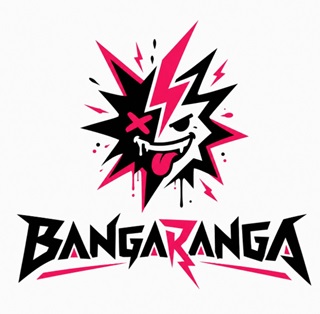
As revealed by open registers, the application was filed with the EU Intellectual Property Office on May 17. Most notably, neither the singer herself nor her producers have any connection to this filing. According to the specified classes of goods and services, the brand is intended for use in the gambling sector—for the production of slot machines, casino chips, and bookmaking services. The applicant has also developed a complete visual design and logos for the name.
Source: https://euipo.europa.eu/eSearch/#basic/1+1+1+1/100+100+100+100/Bangaranga
Who is Behind the Application?
The client’s name is currently classified; according to protocol, it will be revealed only after initial checks and payment of all fees. However, Bulgarian has been chosen as the official language of the procedure, and the client’s interests are represented by Bulgarian patent attorney Ralitsa Zayakova-Krushkova.
The applicant’s representative stated that the brand is being registered by a Bulgarian company with an international profile: “I specify that the application was filed with the European Union Intellectual Property Office precisely by a Bulgarian company with an international presence, and not by a foreign entity attempting to capitalize on Bulgarian cultural success. Bulgaria already has enough examples where designations and reputation associated with Bulgarian origin have been used or registered by foreign, non-Bulgarian entities. In this sense, it is extremely positive that a Bulgarian company has recognized the value of the designation and taken real steps to protect it as a trademark, rather than a foreign company.
It is important to consider that from a legal standpoint, the popularity of a word does not automatically turn it into anyone’s exclusive property. Copyright protects the song, the lyrics, and related rights protect the performer, producers, and the recording, but copyright and related rights do not grant an automatic monopoly on an individual word as a trademark, especially not for one or all economic sectors. In this case, the designation is being filed for products and services in a sector different from the music industry—the gaming and gambling industry, where the Bulgarian state has global significance… Bad faith is not presumed. It must be proven with concrete facts, and the mere popularity of a certain designation is insufficient for such a conclusion. We believe that respect for artistic success does not contradict the right of Bulgarian companies to use established European trademark protection mechanisms to the benefit of Bulgarian companies and Bulgaria. Something we should be happy about and respect.”
Experts’ opinions are divided:
-
Some consider this classic “parasitism” on someone else’s success and an attempt to make a quick profit from global hype. Such actions can be contested in court if it can be proven that the company is acting in bad faith.
-
Others reiterate that in business, the rule is “first come, first served.” Singer DARA’s producers made a mistake and did not protect the song’s title as a trademark in time.
However, the artist’s team still has time. The law allows them to file an official opposition and block the registration of the “gambling brand.“
Interestingly, this is not the first attempt to profit from the song. As it turned out, earlier this year, though only after the track was announced for Eurovision, a cosmetic company quickly purchased the internet domain with the name Bangaranga (case details were not published). This case serves as a prime example of how lightning-fast business reacts to major cultural events, attempting to seize rights to anything that becomes popular.
Founder of Research & Patent group Intectica, author of patent algorithms for solving problems in the pharmaceutical industry, patent attorney certified in all intellectual property objects (Patents, Design, TM), with education in chemistry and law, chief expert of the patent institution of Ukraine UKRPATENT (1997-2004). Member of international organizations, including ECTA, PTMG, UAM, lecturer and blogger.